Course term:
Available seats:
Price:
Category:
Status:
Deadline:
Course term: 19. 07. – 30. 07.
Available seats: 12
Price: 850 €
Category: Bussiness & Marketing
Status: Early Bird
Deadline: 30.04.2027

This summer course will prepare you to be ready to update traditional business models by exploring innovative approaches within the circular economy, emphasizing value creation throughout the product life cycle. Through engaging discussions, collaborative projects, and real-world case studies, you gain insights into sustainable business practices. Connect with like-minded individuals to have meaningful discussions and explore collaborations that contribute to the larger movement towards circularity. Stay ahead in the circular revolution by staying informed about the latest trends, technologies, and strategies in sustainable innovation, equipping yourself to navigate the evolving landscape of environmental responsibility. Embrace a culture of sustainability and be a driving force for positive environmental and economic impacts by visualizing your sustainable personality.
This course is not aimed at one-way transfer of knowledge, but rather aimed at creating a learning space in which you can develop yourself with the continuous support of a coach/lecturer.
” As part of the course students will be creating a Sustainability plan, related to their own background or company. Its a whole 2 week project – from collecting data, working on the project with other students to presenting the project results at the end of the course.”
After introductions (Who are we? What is our carbon footprint?), we will look at the history of sustainability and discuss current challenges: CO2 reduction, energy transition, biodiversity, the circular economy, and human wellbeing.
From theory to practice: Developing your own project/company sustainability plan.
We will examine the concept of “Doughnut Economics,” which proposes that humanity must operate within social and ecological boundaries. We will discuss the social foundations we must provide and the ecological ceilings we must respect to ensure the planet’s health.
Time to focus on your project and the business challenge. We will analyze the value chains of case companies, evaluate their current sustainable practices, and explore how they integrate these into their operations.
After four intensive days of working on your business challenge, we will take a step back to review our progress. We will synthesize our preliminary conclusions, discuss how to help your case company become more sustainable, and reflect on your personal journey and identity.
Exploring methods for sustainable business innovation, with a focus on circularity. You will apply this knowledge to your project, aligning your solutions with the SDGs, the Global Reporting Initiative (GRI) standards, and the Drawdown project’s 100 solutions to reverse global warming.
Validation is crucial when changing business processes. We will evaluate how your case company reacts to your ideas and seek additional insights to refine your strategy.
Today, everything comes together in a final product. Sustainable innovation requires creative, out-of-the-box thinking. Let’s put your right-hemisphere skills to work!
Decision-makers are often hesitant to embrace innovation. We will focus on visualizing your steps to ensure your ideas are practical, persuasive, and ready for implementation.
Saving the best for last! You will pitch your final proposals to the case company. It’s time to show how your ideas can drive real, sustainable change.
University of Leiden
Lecturer at Saxion University of Applied Sciences
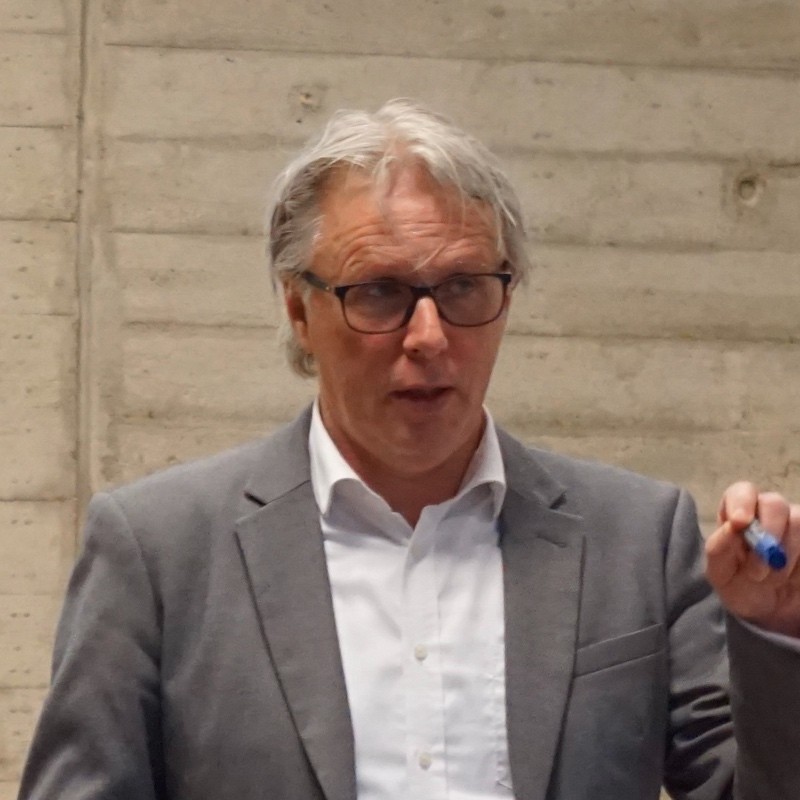
Marcel Slootweg Marcel Slootweg LinkedIn profile Drs. Marcel Slootweg graduated at the State University of Leiden in 1993 as a Historian specialized in contemporary foreign politics. After his study, he started working for Rabobank as a trainee Investment Specialist. From then on he worked in the world of investment management and private wealth management for several Dutch private banks, included ING. He also graded as a Certified Financial Analyst in 2004. This is a post-graduate education in Business Economics, specialised in equity and liabilities. He gained most of his working experience at Staalbankiers (greenfield operation) and Van Lanschot Bankiers (managing two desks of investment specialist and later a greenfield operation in Wealth Management).
After 25 years in banking industry he switched his career to education. He is a lecturer at Saxion University of Applied Science in subjects like Finance, Ethics and Sustainability. He likes sports, especially field hockey, golf and cricket./p>
1) “I liked the depth we went through with the reflections. More specifically, I appreciate the fact that you really went through the documents and gave feedback also from your own experience. It made me felt I could relate more and thus I was able or at least I wanted to go even deeper in my own reflections. The different kinds of assignments were a lot of fun and very educational as well. It was a good way to be creative and be active with my brains by doing other things rather than just reading and discussing. I especially liked that you joined us with the assignments as well! The discussions about theories and then trying to implement or seek for our own examples accordingly was very nice. It gave a good practical sense of understanding and how we can then also could implement in future events. Thank you for sharing your own experience!”
2) “Videos were very inspiring and easy to relate to – I liked the personal point of view and that we had to go really deep into our own heads – You very good teacher and I liked your transparency and that your also shared with us. You made it relevant to our own backgrounds. The wide range of different methodologies we used. The reflections. (Even though it was very demanding sometimes because there was a lot to do all the time, not much rest in general. Nevertheless, I very much appreciate this way of learning and reminding myself about what I have actually learned today and how can I implement this in my own background)”
3) “Use of videos Very good explanations Activities in the course.”
Effective learning involves visualizing information and understanding its practical application (Oakley & Sejnowski, 2018). In this summer course, participants will engage in a real-world case study involving a company in Prague seeking assistance in enhancing sustainability through proposed circular solutions within its existing business model. Working collaboratively within (sub)groups, participants will develop and execute a plan, addressing key considerations such as analysing the business model, identifying improvement opportunities, and creating tailored circular solutions. Decisions on visualization methods for the proposed solutions rest with the groups, emphasizing the role of creativity in sustainability and circular economy initiatives.
The course also prioritizes personal development, specifically in identity identification. While maintaining a fast-paced approach, the course recognizes the value of reflection, providing support through various models and group sessions with the coach. Taking time for reflection and evaluating one’s current position are integral to making substantial progress, even in the pursuit of continuous advancement.
Course fee includes the course itself, application fee, study materials, afternoon/evening social activities and events, welcome and goodbye drink as part of the graduation party. Other expenses, such as meals, accommodation, insurance, personal expenses, public transportation ticket, extra activities (such as trips outside of town over the weekend and entrance fees), and required equipment (i.e. pencils, paper for illustrations) are not included in the price.
Please note, after the 30th of April 2027 there will be a late enrollment fee charged in the amount of 100EUR on top of the course fee.

Feel free to contact our coordinator:
Andrea Josífková
Coordinator
+420 777 879 192
info@europeansummerschool.com

Salma Peter
The new friends... Czech cuisine... the city of Prague... and of course the Kozel (New favorite ?)!! I had an incredible summer experience! The course is a perfect blend of gaining knowledge while having fun and discovering the beautiful city! The program is so well organized, incredible after study activities, easy transportation, friendly team members. It'll be my fondest memory for a while and for that I say: Děkuji ? Highly recommended! ??
Andrea
Besides a lot of information in Marketing which helped me to improve my marketing skills, I met lot of nice and lovely people around whole world. Cultural mix in Summer School was amazing it was 30 nationalities there! I gained an unforgettable experience during summer school in Split. It was lot of fun, many activities and city Split is wonderful! There was always what to do – morning swimming, exercise, learning, city exploring, sightseeing, barbecue, volleyball, and other activities ? Big thanks!

Anna-Christina
A great summer experience where I had the chance to meet people from all over the world. It was also awesome to see Prague and the different views and attractions of the city. I learnt things about communication in business from the course and developed my communication skills. This experience made my summer different!

Maria
You apply for a course, in my case Online Marketing, and you get a lifetime experience. It´s not only the knowledge you gain, it´s the people your meet and the friends you make, the ambitious teachers and caring organizing team you get to know, it´s the spirit of an international summer school that makes these two weeks truly amazing.